Product Description:
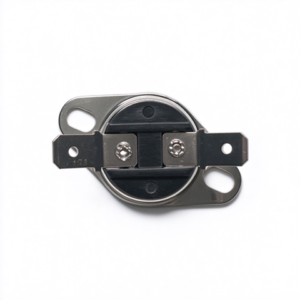
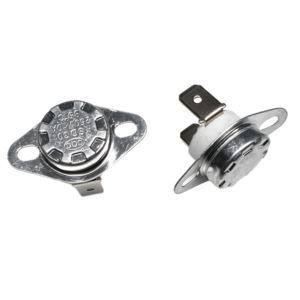
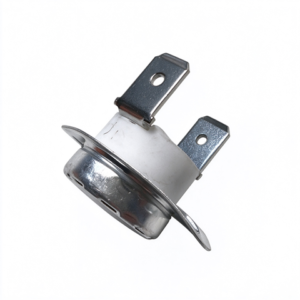
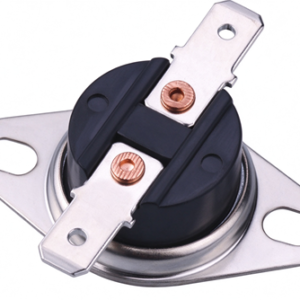
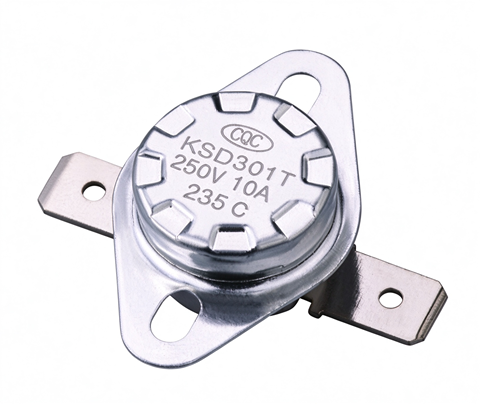
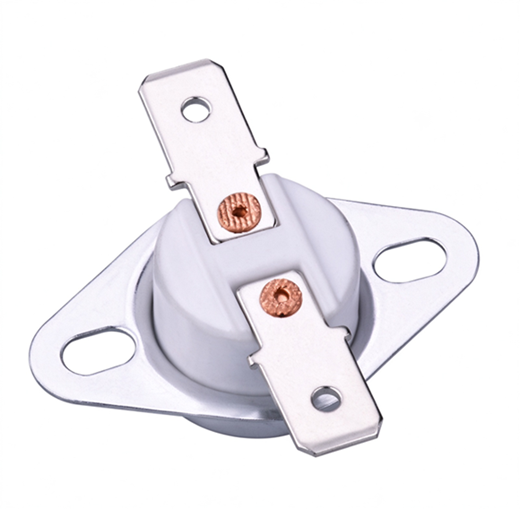
KSD301 °C Limit Thermostat NC 250V 10A Ceramic Housing 180° Terminal from Qimao Electrical unit uses a bimetallic disc as the sensing and switching element. The ceramic housing is the key difference from standard phenolic versions—it handles higher continuous surface temperatures and does not carbonize or lose mechanical strength near the heat source. Contacts are normally closed and open when the disc reaches the preset action point. The 180° terminal orientation allows wiring from the side, which helps in appliances where the thermostat sits flat against a plate or duct. Rated 250V 10A resistive. Auto-reset after cooling. No calibration screw, no external sensor, no control board needed. It works as a standalone thermal cutoff.
Specification:
| Parameter | Specification |
|---|---|
| Model: | KSD301 °C Limit Thermostat NC 250V 10A Ceramic Housing 180° Terminal |
| Material: | Ceramic |
| Action Temperature: | Preset, 180°C typical |
| Contact Form: | SPST, Normally Closed |
| Rated Load: | 10A / 250VAC resistive |
| Housing Material: | Ceramic |
| Terminal Type: | 180° flat terminal |
| Reset Type: | Automatic |
| Differential: | 10–30K |
| Circuit Resistance: | ≤50mΩ |
| Operating Life: | 50,000+ cycles |
| Max Exposure: | Higher than phenolic, ceramic-rated |
Working Principle:
The KSD301 °C Limit Thermostat NC 250V 10A Ceramic Housing 180° Terminal uses a bimetallic disc as both sensor and switch. At room temperature the disc stays convex, holding the normally closed contact together. When the mounting surface reaches the preset limit, the disc snaps to concave, pushing the contact open and cutting power to the load. As the surface cools, the disc snaps back at the reset point, typically 10–30K below the action temperature, and the contact closes again. There is no coil, no spring, and no external sensor—the disc does everything. This is why response is fast and repeatable, and why the trip point does not drift with age.
Features:
-
KSD301 °C Limit Thermostat NC 250V 10A Ceramic Housing 180° Terminal ceramic housing — handles higher surface temperatures than phenolic, no carbonization near the heat source
-
Normally closed SPST — opens on temperature rise, fail-safe for overheat protection
-
250V 10A resistive rating — covers most small-appliance heating loads
-
180° flat terminal — side-entry wiring for tight or flat mounting positions
-
Fixed action point — no field calibration, no drift over time
-
Automatic reset — 10–30K differential, re-closes after cooling
-
≤50mΩ circuit resistance — low voltage drop, less self-heating at the contact
-
50,000+ cycle life — silver contacts resist oxidation and pitting
-
Snap action — fast opening, minimal arcing and RF interference
Application:
-
KSD301 °C Limit Thermostat NC 250V 10A Ceramic Housing 180° Terminal used for electric kettles and water dispensers — dry-boil cutoff on the heating plate
-
Rice cookers and food warmers — overheat limit on the main heating element
-
Microwave ovens — thermal cutoff on the magnetron or cavity wall
-
Space heaters and fan heaters — opens if airflow is blocked or the fan stalls
-
Clothes dryers — limits exhaust air temperature
-
Coffee makers and espresso machines — high-limit cutoff on the boiler
-
Industrial heating plates — surface temperature limit, can drive a relay for higher loads
-
Automotive seat heaters — prevents overheating if the controller fails
Our Advantage:
We form, assemble, and calibrate the KSD301 °C Limit Thermostat NC 250V 10A Ceramic Housing 180° Terminal in-house, which means we control the two variables that actually affect trip point: disc heat treatment and contact gap setting. Ceramic housings are sourced from a qualified supplier and checked for dimensional consistency before assembly. Each batch is sampled at 100%, 75%, and 50% rated load—not just no-load. Contact resistance is verified after 100 operations to catch early wear. Because we make the disc ourselves, action temperatures from 40°C to 220°C are available without tooling delays. Custom terminal angles, ring dimensions, and lead lengths take 7–10 days for samples.